1200 stories
·
0 followers

After court loss, RFK Jr. gives himself more power over CDC vaccine panel

1 Share

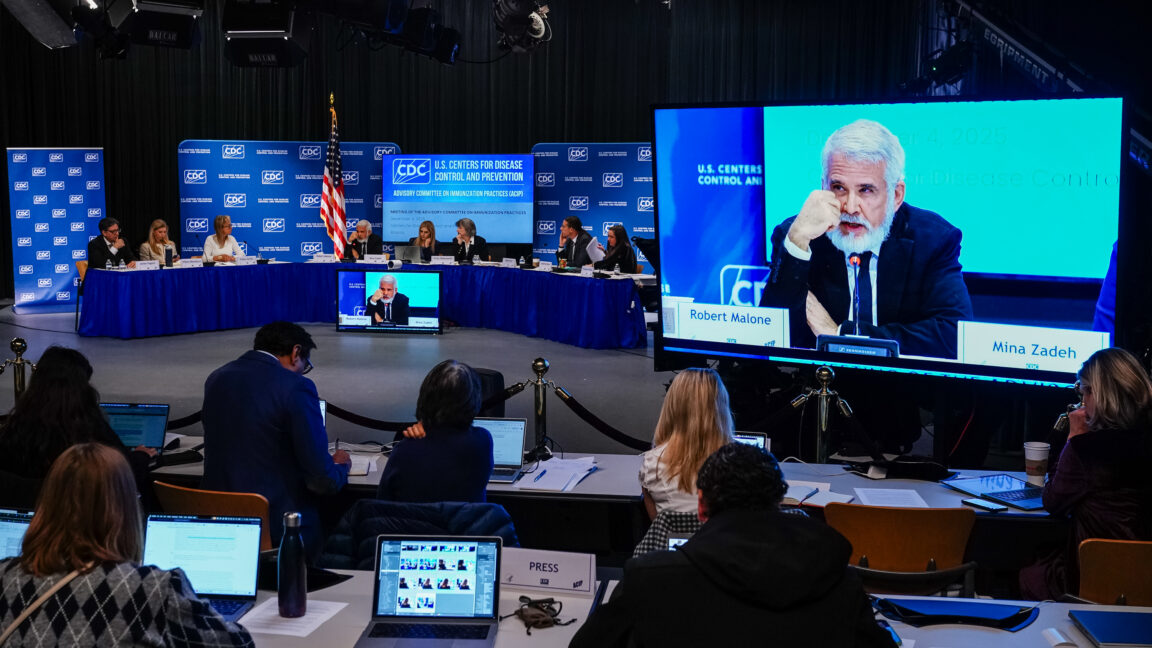
Anti-vaccine Health Secretary Robert F. Kennedy Jr. has amended the charter of a federal vaccine advisory panel to seemingly grant himself more power to hand-pick members and loosen membership requirements, according to a notice published today in the Federal Register.

The changes come after a federal judge last month temporarily blocked advisors Kennedy had hand-selected, following his firing of all 17 experts from the Centers for Disease Control and Prevention's Advisory Committee on Immunization Practices (ACIP). The judge, US District Judge Brian Murphy, ruled that Kennedy's anti-vaccine-leaning picks largely lacked expertise in relevant fields as required under the current charter. They also failed to meet broader federal regulations that advisory committees be "fairly balanced" in representing the views within relevant fields.

"A committee of non-experts cannot be said to embody 'fairly balanced… points of view' within the relevant scientific community," Murphy wrote. "It is more accurate to say that they do not represent points of view within the relevant expert community."

The ruling has suspended all activity of the ACIP panel. It also temporarily reverses all the changes Kennedy's ACIP had made to federal vaccine policy, including dropping recommendations for COVID-19 vaccines and a birth dose of the Hepatitis B vaccine. Both were widely decried by medical and public health organizations.

The updated charter published today may be Kennedy's next move to restore his vision for ACIP, which he had largely stocked with allies that share his anti-vaccine views.

Broad authority

ACIP's charter is renewed every two years, and the last renewal period ended April 1, 2026. For at least the last two decades, renewal notices in the Federal Register have been brief and unremarkable. But this year's renewal laid out a significant amount of new language, some of which addressed the criteria for selecting members.

Most notably, the current charter includes a lengthy sentence on membership terms that begins by stating that ACIP members "shall be selected by the Secretary ..." But the renewal notice today includes a nearly identical sentence, with the change that ACIP members "shall be selected and appointed by the HHS Secretary." The edit appears to enshrine Kennedy's ability to unilaterally install ACIP members.

The membership criteria are also dramatically different between the current charter and today's renewal. Currently, ACIP members "shall be selected from authorities who are knowledgeable in the fields of immunization practices and public health, have expertise in the use of vaccines and other immunobiologic agents in clinical practice or preventive medicine, have expertise with clinical or laboratory vaccine research, or have expertise in assessment of vaccine efficacy and safety." These specific core requirements of expertise in immunization practices and vaccine science were central to Murphy's findings that Kennedy's appointees were unfit to be on the committee.

The renewal notice did not mention these criteria, but instead discussed members having a "geographic balance" (representing different parts of the country) and a "balance of specialty areas." It provided a lengthy list of specialty areas that span a much larger swath of medical and scientific fields and potentially beyond. They include: "biostatistics, toxicology, immunology, epidemiology, pediatrics, internal medicine, family medicine, nursing, consumer issues, state and local health department perspective, academic perspective, public health perspective, etc."

Suggested changes

Some of the changes in the renewal may stem from a push made by an anti-vaccine group close to Kennedy. The group is Informed Consent Action Network (ICAN), headed by Kennedy's anti-vaccine ally Del Bigtree, who is working with Aaron Siri, a lawyer who worked on Kennedy's failed presidential campaign and has filed numerous lawsuits seeking compensation for alleged vaccine injuries. Siri is also notable for petitioning the Food and Drug Administration to revoke the polio vaccine.

Last month, ICAN urged Kennedy to revise ACIP's charter, and Siri's law firm provided a draft, complete with track-changed text, of what they want for the new charter. The draft states that ACIP members should have expertise in any area "deemed relevant by the Secretary." But, it specifically states that "At least two members shall have direct and substantial experience advocating for and/or treating those injured by vaccines."

The Department of Health and Human Services did not respond to questions from Ars Technica about changes to the renewal notice or potential updates to the CDC's full charter language. Spokesperson Andrew Nixon only said in an emailed statement that the renewal is part of "routine statutory requirements and do not signal any broader policy shift."
Read full article

Comments


Read the whole story
Share this story
Delete

How do you add or remove a handle from an active Wait­For­Multiple­Objects?

2 Shares

Last time, we looked at adding or removing a handle from an active Msg­Wait­For­Multiple­Objects, and observed that we could send a message to both break out of the wait and update the list of handles. But what if the other thread is waiting in a Wait­For­Multiple­Objects? You can’t send a message since Wait­For­Multiple­Objects doesn’t wake for messages.

You can fake it by using an event which means “I want to change the list of handles.” The background thread can add that handle to its list, and if the “I want to change the list of handles” event is signaled, it updates its list.

One of the easier ways to represent the desired change is to maintain two lists, the “active” list (the one being waited on) and the “desired” list (the one you want to change it to). The background thread can make whatever changes to the “desired” list it wants, and then it signals the “changed” event. The waiting thread sees that the “changed” event is set and copies the “desired” list to the “active” list. This copying needs to be done with Duplicate­Handle because the background thread might close a handle in the “desired” list, and we can’t close a handle while it is being waited on.

wil::unique_handle duplicate_handle(HANDLE other)
{
    HANDLE result;
    THROW_IF_WIN32_BOOL_FALSE(
        DuplicateHandle(GetCurrentProcess(), other,
            GetCurrentProcess(), &result,
            0, FALSE, DUPLICATE_SAME_ACCESS));
    return wil::unique_handle(result);
}

This helper function duplicates a raw HANDLE and returns it in a wil::unique_handle. The duplicate handle has its own lifetime separate from the original. The waiting thread operates on a copy of the handles, so that it is unaffected by changes to the original handles.

std::mutex desiredMutex;
_Guarded_by_(desiredMutex) std::vector<wil::unique_handle> desiredHandles;
_Guarded_by_(desiredMutex) std::vector<std::function<void()>> desiredActions;

The desiredHandles is a vector of handles we want to be waiting for, and the The desiredActions is a parallel vector of things to do for each of those handles.

// auto-reset, initially unsignaled
wil::unique_handle changed(CreateEvent(nullptr, FALSE, FALSE, nullptr));

void waiting_thread()
{
    while (true)
    {
        std::vector<wil::unique_handle> handles;
        std::vector<std::function<void()>> actions;
        {
            std::lock_guard guard(desiredMutex);

            handles.reserve(desiredHandles.size() + 1);
            std::transform(desiredHandles.begin(), desiredHandles.end(),
                std::back_inserter(handles),
                [](auto&& h) { return duplicate_handle(h.get()); });
            // Add the bonus "changed" handle
            handles.emplace_back(duplicate_handle(changed.get()));

            actions = desiredActions;
        }

        auto count = static_cast<DWORD>(handles.size());
                        
        auto result = WaitForMultipleObjects(count,
                        handles.data()->addressof(), FALSE, INFINITE);
        auto index = result - WAIT_OBJECT_0;
        if (index == count - 1) {
            // the list changed. Loop back to update.
            continue;
        } else if (index < count - 1) {
            actions[index]();
        } else {
            // deal with unexpected result
            FAIL_FAST(); // (replace this with your favorite error recovery)
        }
    }
}

The waiting thread makes a copy of the desiredHandles and desiredActions, and adds the changed handle to the end so we will wake up if somebody changes the list. We operate on the copy so that any changes to desiredHandles and desiredActions that occur while we are waiting won’t affect us. Note that the copy in handles is done via Duplicate­Handle so that it operates on a separate set of handles. That way, if another thread closes a handle in desiredHandles, it won’t affect us.

void change_handle_list()
{
    std::lock_guard guard(desiredMutex);
    ⟦ make changes to desiredHandles and desiredActions ⟧
    SetEvent(changed.get());
}

Any time somebody wants to change the list of handles, they take the desiredMutex lock and can proceed to make whatever changes they want. These changes won’t affect the waiting thread because it is operating on duplicate handles. When finished, we set the changed event to wake up the waiting thread so it can pick up the new set of handles.

Right now, the purpose of the changed event is to wake up the blocking call, but we could also use it as a way to know whether we should update our captured handles. This allows us to reuse the handle array if there were no changes.

void waiting_thread()
{
    bool update = true;                        
    std::vector<wil::unique_handle> handles;   
    std::vector<std::function<void()>> actions;

    while (true)
    {
        if (std::exchange(update, false)) {
            std::lock_guard guard(desiredMutex);

            handles.clear();
            handles.reserve(desiredHandles.size() + 1);
            std::transform(desiredHandles.begin(), desiredHandles.end(),
                std::back_inserter(handles),
                [](auto&& h) { return duplicate_handle(h.get()); });
            // Add the bonus "changed" handle
            handles.emplace_back(duplicate_handle(changed.get()));

            actions = desiredActions;
        }

        auto count = static_cast<DWORD>(handles.size());
                        
        auto result = WaitForMultipleObjects(count,
                        handles.data()->get(), FALSE, INFINITE);
        auto index = result - WAIT_OBJECT_0;
        if (index == count - 1) {
            // the list changed. Loop back to update.
            update = true;
            continue;
        } else if (index < count - 1) {
            actions[index]();
        } else {
            // deal with unexpected result
            FAIL_FAST(); // (replace this with your favorite error recovery)
        }
    }
}

In this design, changes to the handle list are asynchronous. They don’t take effect immediately, because the waiting thread might be busy running an action. Instead, they take effect when the waiting thread gets around to making another copy of the desiredHandles vector and call Wait­For­Multiple­Objects again. This could be a problem: You ask to remove a handle, and then clean up the things that the handle depended on. But before the worker thread can process the removal, the handle is signaled. The result is that the worker thread calls your callback after you thought had told it to stop!

Next time, we’ll see what we can do to make the changes synchronous.

The post How do you add or remove a handle from an active <CODE>Wait­For­Multiple­Objects</CODE>? appeared first on The Old New Thing.

Read the whole story
Share this story
Delete

Trump's emergency orders pushing coal power are illegal as well as dumb

1 Share

At one time, the US electricity grid ran mostly on coal.

But coal-fired power plants have steadily been decommissioned. Power producers found the plants were too expensive to operate and carried risks tied to toxic air pollution, waste and climate-warming emissions.

Then President Donald Trump returned to the White House last year with a fresh zeal to revive the coal industry. His Department of Energy invoked emergency powers to force utilities to keep old plants operating.

Not only is this bad policy, it’s also a misuse of a law designed for wartime, according to legal scholars and analysts. If allowed to stand, this poses problems for utilities, grid operators and regulators who plan for decades-long timeframes, only to be overruled by short-term political imperatives that favor certain industries.

“It’s just illegal,” said Alexandra Klass, a professor at University of Michigan Michigan Law School, about the emergency orders. She served in the Biden administration as a deputy general counsel at the Department of Energy.

Environmental advocates and state officials have challenged the orders in court, with cases underway in the US Court of Appeals for the District of Columbia Circuit.

I’m focusing on the emergency orders because I don’t think the public grasps how much these actions undermine the principles of utility planning and regulation, with harmful consequences for consumer bills and the climate.

While the Trump administration props up coal, it aims to slow the deployment of clean alternatives with actions such as a stop-work order on offshore wind and slow-walking permits to build onshore wind.

Klass co-authored a new essay with Dave Owen of UC Law San Francisco in the Michigan Law Review Online that examines the history and current use of presidential emergency powers on energy.

The Department of Energy under President Donald Trump is invoking Section 202(c) of the Federal Power Act, a provision first used by President Franklin D. Roosevelt in 1941 to meet electricity demand in the Southeastern United States in the run-up to US entry into World War II. The idea was that the government needed the ability to step in to meet short-term needs when existing regulations failed to do so.

The government issued 23 orders under Section 202(c) during the 1940s and almost none in the decades that followed.

In the first Trump administration and the Biden administration, the Department of Energy used the power 12 times in response to requests from utilities or grid operators, usually for permission to operate plants briefly in excess of emissions limits.

Since returning to office in 2025, Trump has used this power differently, seemingly to benefit coal producers by preventing coal plants from closing. The key difference is that this latest wave of orders, starting in May 2025 with the JH Campbell plant in Michigan, was not sought by plant owners.

“What the administration is doing now is using these 202(c) orders to basically override all of the long-term resource adequacy and grid planning that states, regional transmission organizations and utilities do,” Klass said. “And this is now coming in saying, ‘We don’t care what any of you experts and planners have to say. We want to save the coal industry, and we’re going to use this emergency authority that’s not designed for long-term resource planning.’”

Consumers Energy, the utility that operates JH Campbell, had planned to close the plant and replace it with a less-expensive combination of a natural gas plant and renewables that already were online.

Think of this in terms of the car you drive. You bought a new car and then the government says you need to keep your old one and continue driving it, even if it’s spewing black smoke and costs more to run than your new one.

The JH Campbell plant, opened in 1960, has a summer generating capacity of 1,331 megawatts. In 2024, it emitted 8.9 million tons of carbon dioxide, ranking 19th among US power plants, based on an analysis of federal Energy Information Administration data.

It got its fuel last year from the country’s two largest coal mines by production, North Antelope Rochelle Mine and Black Thunder, according to regulatory filings. Both are based in Wyoming and they are owned by Peabody Energy and Core Natural Resources, respectively.

James Grech, Peabody’s CEO, is also the chair of the Department of Energy’s National Coal Council. Jimmy Brock, Core’s CEO, is the vice chair. The Trump administration reconstituted the council last year after it had lapsed under the Biden administration. It was founded during the Reagan administration and advises the secretary of energy on policy, technology and markets.

I reached out to Peabody and Core and did not receive an immediate response.

Since ordering JH Campbell to remain open, the Trump administration has issued orders for five other plants: Eddystone in Pennsylvania, Centralia in Washington, RM Schahfer and Culley in Indiana and Craig Station in Colorado. All run on coal except for Eddystone which runs on natural gas and oil.

And, the administration may just be getting started.

“I think as part of the national energy emergency which President Trump has declared we’ve got to keep every plant open,” said Interior Secretary Doug Burgum last month in an interview with Bloomberg News. “And if there have been units at a coal plant that have been shut down, we need to bring those back on.”

For context, the country has 169,417 megawatts of coal-fired power plants.

Of that total, 40,784 megawatts have retirement dates listed by the EIA. More than half of that total is set to shut down before 2029 and would be caught up in a policy barring the closure of any coal plant on Trump’s watch.

While the administration can slow the decline, coal’s long-term retreat is near-inevitable. As recently as 2005, the country generated at least half of its electricity from coal-fired power plants. The share plummeted to a low of 15 percent in 2024, then rebounded slightly to 17 percent in 2025.

For coal power to make a sustained comeback in this country, developers would need to start building new plants. The best possibility right now may be the Terra Energy Center in Alaska, a proposal to build a 1,250-megawatt coal-fired power plant that would be the first of its kind in the United States since 2013. But this kind of project is speculative, and it’s not yet clear that it will find the right combination of financing and reliable coal supply.

Energy Secretary Chris Wright had said the emergency orders are necessary to keep electricity reliable and affordable.

“The states that have rushed to close their coal plants have also had rapidly escalating electricity prices,” he said in a Jan. 19 appearance on Fox Business. “Americans don’t like that. President Trump doesn’t like it.”

His comment leaves a lot to unpack for an energy analyst. But rather than go into the reasons electricity prices have risen, which is something Marianne Lavelle and I covered in- depth for ICN last month, I’ll just note that the administration’s policy is making power more expensive.

In a February regulatory filing, Consumers Energy reported that it had spent $290 million to operate the plant since the first emergency order. Of this total, $155 million was offset by revenue from the grid operator, leaving $135 million to be covered by the utility’s customers.

“It’s definitely interfering with the ability of utilities to make sure that they’re able to supply the lowest cost, most reliable energy to their customers, as well as states’ abilities to plan their own generation,” said Michelle Solomon, a manager in the electricity program at the think tank Energy Innovation.

If the courts don’t rein in Trump’s use of 202(c), then there is little recourse. Congress could seek to modify the law on emergency powers, but that seems far from likely.

If we want a system in which experts make decisions based on the public interest and economics, then leaders will need to spend the post-Trump years making rules that aren’t so easy to abuse.

This story originally appeared on Inside Climate News.

Read full article

Comments


Read the whole story
Share this story
Delete

Sports bets on prediction markets ruled to be "swaps," exempt from state laws

1 Share

A federal appeals court ruled that New Jersey cannot regulate sports bets on prediction markets because the US Commodity Futures Trading Commission (CFTC) has exclusive jurisdiction.

Kalshi, which is registered with the CFTC as a designated contract market (DCM), last year won a preliminary injunction preventing the New Jersey Division of Gaming Enforcement from enforcing a state law against its sports-related event contracts. The injunction issued by a district court was upheld today in a 2-1 decision by judges at the US Court of Appeals for the 3rd Circuit.

The CFTC has exclusive jurisdiction over DCMs under the Commodity Exchange Act, a US law. The question in the Kalshi lawsuit is whether the CFTC's exclusive jurisdiction "preempts New Jersey gambling laws and the state constitution’s prohibition on collegiate sports betting," the appeals court majority wrote. "New Jersey frames the issue broadly (regulating all sports gambling) rather than narrowly (regulating trading on federally designated contract markets)."

Chief Judge Michael Chagares and Circuit Judge David Porter sided with Kalshi in a decision written by Porter, saying that the federal law's text "suggests that the narrow framing is the better reading." It thus "preempts state laws that directly interfere with swaps traded on DCMs. Kalshi’s sports-related event contracts are swaps traded on a CFTC-licensed DCM, so the CFTC has exclusive jurisdiction."

The case began last year after New Jersey sent a cease-and-desist letter to Kalshi, alleging that it was listing unauthorized sports wagers in violation of the New Jersey Sports Wagering Act and the New Jersey constitution. The state's Sports Wagering Act requires licenses to offer sports wagers, and the state constitution prohibits betting on college sports.

"Virtually indistinguishable" from online sportsbooks

Circuit Judge Jane Roth dissented, writing that the Kalshi "offerings are virtually indistinguishable from the betting products available on online sportsbooks, such as DraftKings and FanDuel." Roth recounted looking at the Kalshi page for the Carolina Panthers versus Tampa Bay Buccaneers football game on January 3, 2026, and seeing an extensive list of available bets.

"I could have bet on the winner (game outcome). I could have also bet on whether I believed Tampa Bay would win by more than 2.5 points (point spread), whether the two teams would collectively score 45 or more points (game props), or whether former Tampa Bay wide receiver Mike Evans would score a touchdown (player props)," she wrote.

Online sportsbooks offering similar wagers are regulated by states such as New Jersey, but "Kalshi asserts that it is outside the bounds of state regulation because it does not offer gambling products," Roth wrote. "Instead, Kalshi contends its offered sports-event contracts are swaps, subject to the exclusive jurisdiction of the CFTC. The Majority agrees, holding that Kalshi’s registration as a DCM and branding of its wagers as sports-event contracts are acts of alchemy that transmute its products from sports gambling to futures trading. I see Kalshi’s actions as a performative sleight meant to obscure the reality that Kalshi’s products are sports gambling. Because Kalshi is facilitating gambling, it can be subjected to state regulation."

This is apparently the first appeals court ruling on the topic, but it probably won't end the ongoing debate about the regulation of sports wagers on prediction markets. As law firm Holland & Knight wrote in February, Kalshi has gotten favorable rulings at the US district court level in New Jersey and Tennessee, but suffered losses in Maryland and Nevada.

"With nearly 50 active cases addressing the oversight of event contracts—involving multiple platforms across jurisdictions from New York to Nevada to Tennessee—courts at every level are now grappling with fundamental questions of federalism, preemption and statutory interpretation," Holland & Knight wrote.

CFTC defends "exclusive" authority

The CFTC filed lawsuits last week against Arizona, Connecticut, and Illinois to challenge the states' attempts to regulate prediction markets. “The CFTC will continue to safeguard its exclusive regulatory authority over these markets and defend market participants against overzealous state regulators,” CFTC Chairman Michael Selig said on Thursday. The agency is also seeking public comment on how it should regulate prediction markets, including those related to gaming.

Congress could step in. On March 23, Senator Adam Schiff (D-Calif.) and Senator John Curtis (R-Utah) introduced legislation to prohibit CFTC-registered entities from listing prediction contracts that resemble sports bets or casino-style games.

“Sports prediction contracts are sports bets—just with a different name," Schiff said. "And yet, these contracts have been offered in all fifty states in clear violation of state and federal law. Rather than enforce the law, the CFTC is greenlighting these markets and even promoting their growth. It’s time for Congress to step in and eliminate this backdoor which violates state consumer protections, intrudes upon tribal sovereignty, and offers no public revenue."

Curtis said he's worried about young people being "exposed to addictive sports betting and casino-style gaming contracts that belong under state control, not under federal regulators. Our bipartisan legislation clarifies regulatory jurisdiction, ensuring that states can maintain their authority over sports betting and casino gaming."

Swaps defined broadly in US law

The 3rd Circuit ruling said the Dodd-Frank Act of 2010 amended the Commodity Exchange Act by "adding a new class of futures known as 'swaps' and expanding the CFTC’s exclusive jurisdiction 'with respect to accounts, agreements... and transactions involving swaps or contracts of sale of a commodity for future delivery... traded or executed on a [DCM.]'"

Under the law, swaps include event contracts, judges noted. The Dodd-Frank Act gave the CFTC discretionary power to review and prohibit six categories of contracts if it concludes any violate the public interest. Those categories include gaming contracts. So far, the CFTC "has not yet acted to review or prohibit any sports-related event contracts," the ruling said.

"Congress gave the CFTC exclusive jurisdiction over trades on DCMs, provided for continued state regulation of trades conducted off DCMs, and recognized that while event contracts could involve gaming, the CFTC has discretionary power to review and prohibit those contracts," the majority said. "Thus, it was reasonable for the District Court to conclude that Kalshi was likely to succeed in showing that the Act preempts New Jersey law from reaching into Kalshi’s CFTC-licensed DCM to ban sports-related event contracts."

Roth's dissent acknowledged that a plain reading of the US law's "text suggests that Kalshi’s sports-event contracts fit comfortably within the statutory definition" of swaps. "On the other hand, we should not read statutes literally 'if reliance on that language would defeat the plain purpose of the statute,' or would 'def[y] rationality,'" she said. "As New Jersey argues, Kalshi’s proffered definition would likely encompass virtually every kind of wager that could exist, including classic casino games and charity raffles."

The law defines swap to include contracts in which payment "is dependent on the occurrence, nonoccurrence, or the extent of the occurrence of an event or contingency associated with a potential financial, economic, or commercial consequence." Roth said that with this expansive definition, "even a bet over the outcome of a friendly neighborhood ping pong match" would qualify.

"Moreover, because the trading of swaps outside DCMs is illegal under 7 U.S.C. § 2(e), any individual who engages in gambling outside of a DCM would commit a felony were we to take the definition of swaps to its logical extreme," Roth wrote. "Congress could not have intended for such a rationality-defying outcome."

Read full article

Comments


Read the whole story
Share this story
Delete

Trump's next budget once again calls for massive cuts to science

2 Shares

On Friday, the Trump administration released its proposed budget for 2027. The budget blueprint includes significant cuts to NASA, but it targets even more severe limits for other science-focused agencies, with no agencies spared. The document is laced with blatantly political language and resurfaces grievances that have been the subject of right-wing ire for years.

If all of this sounds familiar, it's because the document is largely a retread of last year's proposal, which Congress largely ignored in providing relatively steady research budgets. By choosing to issue a similar budget, the administration is signaling that this is an ongoing political battle. And the past year has shown that, even if Congress is unwilling to join it in the fight, the administration can still do significant damage to the scientific enterprise.

What's proposed?

Nearly everybody is in for a cut. The hardest-hit agencies, like the National Science Foundation (NSF) and Environmental Protection Agency (EPA), will see their budgets slashed in half. But even agencies that might be otherwise popular, like the National Institutes of Health (NIH), which is overseen by Trump allies, will see $5 billion taken from its $47 billion budget. Agencies that have seemingly avoided political controversies, such as the National Institute of Standards and Technology (NIST), would also see their budgets cut by over half.

In several cases, the cuts will eliminate major programs. For example, the NSF budget for social science research would be zeroed out; the NIH would lose both the National Institute on Minority Health and Health Disparities and the National Center for Complementary and Integrative Health.

In addition, a couple of topic areas are targeted for cuts in multiple agencies. These include efforts to track and/or limit the impacts of climate change, which are targeted for cuts in a variety of agencies. This is what triggered the cuts at NIST. "The Budget slashes wasteful spending at NIST that has long funded awards for the development of curricula that advance a radical climate agenda," the budget proposal announces. "NIST’s Circular Economy Program exploited grants to universities to push environmental alarmism."

Similarly, programs that tackle disparities due to income or discrimination would also be cut. Even though things like health and environmental disparities based on race have been extensively documented, the budget treats any attempts to study them further or address them as illegal discrimination.

In a number of agencies, the administration is also shifting priorities, most notably in the Department of Energy and the NSF, where AI and quantum technologies are now expected to be major areas of focus. The reasoning behind this is unclear, given that these are already areas where private equity has poured large sums of money. It's notable that, depending on exactly how Congress allocates the budget, these agencies may be able to shift focus to these topics even if they are not explicitly directed to do so by law.

A culture war document

While the numbers next to the dollar signs tell us a lot about the administration's thinking, the document is striking for its over-the-top language. The Office of Management and Budget appears nearly incapable of using terminology like "climate change" or "sustainability." Instead, these topics are consistently referenced with variants of the term "green new scam." For example, in slashing the Department of Energy's science budget, the document says, "The Budget eliminates funding for climate change and Green New Scam research." Similar language features in cuts to NIST and ARPA-E.

The budget also makes some references to yearslong right-wing grievances. Apparently, the Trump administration is still upset that incandescent light bulbs have been replaced—something that dates back to a 2007 law. Yet the 2027 budget is still complaining about an agency that "was responsible for many Green New Scam efforts like research on wind energy and a slew of unpopular regulations harmful to Americans in their day-to-day lives, such as banning gas stoves and incandescent light bulbs." (The gas stove ban hasn't happened.)

Similarly, Anthony Fauci, who retired at the end of 2022, is apparently still influencing budgeting decisions in 2026, as he's cited as contributing to "wasteful and radical" spending at the NIH. The specific radicalness cited includes that "Dr. Fauci also commissioned 'The Proximal Origin of SARS-CoV-2' publication, which was used to discredit and dismiss any assertion that COVID-19 leaked from a lab." It's notable that the virus's natural origins are now widely accepted by the scientific community.

Beyond that, many sections of the document include short lists of grant titles presented as examples of wasteful or radical research. This is a standard tactic that goes back decades; often, the grants are fairly mundane or address issues like health disparities that were priorities for past Republican and Democratic administrations.

What to expect

The new budget is largely a variation on the one Trump had submitted for 2026, which Congress largely ignored. The chance that it will approve the same thing in 2027 seems remote. The only factors that might influence it are that the Republican Party is currently looking to lose control of Congress in the upcoming midterm elections, meaning this will likely be the last chance the administration has to pass something like this, which may cause it to push harder for its passage. There's also the potential that the political calculus changes as the full economic and budgetary impact of the war in Iran becomes apparent.

That said, the past year has demonstrated that the administration can do a fair amount of damage to science even when Congress keeps funding constant. For example, last year saw NASA waste resources on planning to shut down missions based on the expectation that Trump's budget would pass, only to receive funding to carry on the missions as normal. And the NIH has been changing how it funds many grants, which has meant that it funds far fewer while spending the same amount of money.

So, the degree to which science gets disrupted goes back to the same issue we saw last time: Is it possible for Congress to put enough conditions on the funding to limit the administration's attempts to subvert its intent?

Read full article

Comments


Read the whole story
Share this story
Delete

NASA shares incredible photos from the far side of the Moon

1 Share

The Artemis II crew made history as they traveled further from our planet than any other living humans. The astronauts and NASA are making the most of the trip, including by capturing some utterly stunning photos. The space agency shared some that were taken from the far side of the Moon, including the "Earthset" shown above.

This is a depiction of our planet setting behind the Moon, just as the sun sets over the horizon for us on terra firma every single night. "The image is reminiscent of the iconic Earthrise image taken by astronaut Bill Anders 58 years earlier as the Apollo 8 crew flew around the Moon," the NASA Artemis account on X noted. 

The crew also witnessed a solar eclipse from the far side of the Moon, with the satellite totally blocking out the sun. This lasted for around 57 minutes as Orion travelled more than 4,000 miles beyond the Moon. You can see several photos of the eclipse and Earth from the lunar flyby in the slideshow above. (And yes, the astronauts used eclipse glasses to protect their eyes.)

While they were circling the Moon, the Artemis II crew discovered two new craters. The astronauts suggested names for them: Integrity (after the nickname for their spacecraft) and Carroll, after the late wife of Commander Reid Wiseman, describing the latter as a “bright spot on the Moon.” 

The mission will last a few more days as the astronauts are now returning to Earth. Orion is scheduled to splash down in the Pacific Ocean near San Diego on April 10.

This article originally appeared on Engadget at https://www.engadget.com/science/space/nasa-shares-incredible-photos-from-the-far-side-of-the-moon-142355972.html?src=rss

Read the whole story
Share this story
Delete
Next Page of Stories